Scientific Name : Lepidochelys olivacea
Type : Reptile , Status : Vulnerable
Distribution: Nesting sites all over the world, on tropical and subtropical beaches
Body Size (adults) : Length 60-70 cm; mass up to 70 kg
Life span in the wild : Average 50 years.
Diet : For all life stages, mostly benthic invertebrates (e.g. crabs of all types, other crustaceans; mollusks) and sometimes jellies
Hatchling emerge : : 45 - 58 days after incubation
Gestation Period : :50 days .The female olive ridley have the capacity to keep fertilised eggs inside their body for a large period till they get proper environment and location to lay eggs.
Reproduction : Every 1-3 yr; ~1-3 clutches of eggs per season; 90-130 eggs per clutch; ~30 g grams each (ping-pong ball size); ~25mm in length and weigh ~15- 20grams).Once a nest has been completed, the female never returns to it. The eggs and resulting hatchlings are left to fend for themselves and locate the water upon emerging.
Gender : The temperature of the nest determines a hatchling's gender. This is called Temperature-Dependent Sex Determination (TSD). Warmer temperatures produce mostly females, and cooler temperatures produce a majority of males. There is a pivotal temperature that produces an equal ratio of males and females. The temperature determining sex ratio differs between species and nest location.
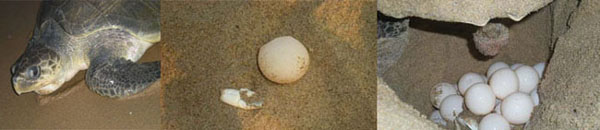
Threats : Beach erosion, non-human predation, exploitation for meat and eggs, Casuarina plantations & Mechanised fishing Boats (More details) .
Odisha coast favorable for sea turtles : Odisha coast is crises-crossed by estuary, rivers, creeks and creek lets, Land inundated by the saline and sweet water and covered with mangroves, Estuaries are the breeding and spawning grounds fishes, prawns, crabs and mollusks. The river mouth becomes the feeding ground of the sea turtles from October to May , therefore they having migrated over large distances in the sea to feed and nesting.
About 50% of the total world population of Olive Ridleys, and 90% of the Indian population of sea turtles been coming every year . Worldwide attention is needed for conservation of this species.
Nesting period : From October to early summer
How to reach:
.jpg)
Nesting Places of Odisha
Major breeding grounds:- Rushikulya , Dhamra and Devi estuary
Minor breeding grounds:- Mahanadi, Subarnarekha, Budhabalanga, Keluni & Bahuda estuary


.gif)